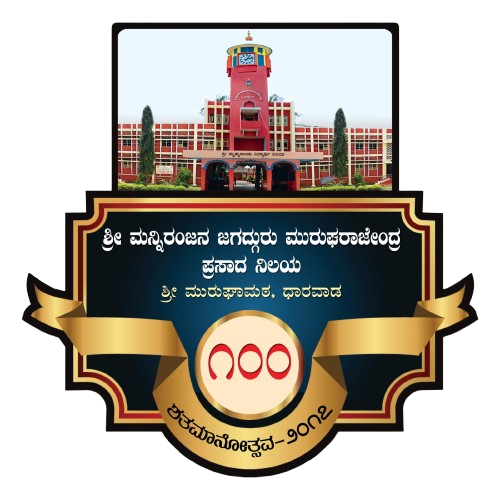
The upliftment of the poor through education, formal as well as non-formal, was the mission of His Holiness Shri Mrityunjaya Swami. It was this noble ideal that prompted Sri Mrityunjaya Swamiji to start the Murugha Rajendra Prasad Nilaya at Dharwad. The starting of this institution at a time when it was very badly needed, with the Karnataka College coming into being just then, heralded a new era of awakening among the masses.
The whole concept of Prasada Nilaya reminds one of the Oxford and Cambridge Universities. The mighty institutions there have been built around the Churches. Religion as a force would mould the character of the students and teachers. Shri Mrityunjaya Swamiji foresaw the evils of modern education divorced from religious and spiritual teaching. So he wanted the students who would be taking up education in schools and colleges to be housed on the premises of the Math itself which was breathing a new spiritual life. He wanted the Math to be a centre of great religious, cultural and educational activities.
The Swamiji built 63 rooms to commemorate the 63 Puratanas. These 63 puratanas hailed from Tamil country and included such saints as Bedar Kannappa, Tirunila Kanthar, Sambandhar, Appar etc. It is said that devotion had its genesis in the South (Utpanna Daxine Dese). This is borne out by such a movement as that of the puratanas. These puratanas were held in high reverence by the Shivasharanas of the 12th Century - Basaveshwar etc., who were known as Nutana puratanas, i.e. Neo puratanas. Some roots of devotion of the new Sharanas, like Basaveshwara were to be traced to the puratanas in the sense that it was sahaja or natural devotion. Bhakti, Jnana and Kriya had become very much artificial in the traditional Hinduism. The form, the puja, the mantra and tantra were given more importance than the soul stirring devotion.
Shri Basaveshwara cast off all these outer formalities and said, "I will sing in my own way although I am not conversant with raga, tala and laya". The devotion of the puratanas who flourished between the 5th and 9th century A.D. in Tamil Nadu was exactly of this type, which is borne out by the life of Kannappa, Shiriyal etc. One would wonder how deeply Shri Mrityunjaya Swamiji has thought about it. Scholars and historians of Virashaiva religion and philosophy, it is hoped, would ponder over this. This great idea of the puratanas appears to be a flash of his intuition.
Sixty-three rooms, each bearing one name of the 63 puratanas, forms a quadrangle. At the centre of the quadrangle is installed the statue of the great Shivayogi of Athani - his own guru. His morning and evening pradaxinas (rounds) around the statue and around the rooms would serve the purpose of his devotional and supervisory activities. The inmates would be thrilled by his presence. Day and night they would be vigilant. The bell would ring at 5 a.m. and all the students would join the Swamiji for prayer and after that they would be going for studies. The humming activities of the Math, religious, cultural or educational throughout the year would certainly mould the character of the students and thus give a sound and solid foundation of spirituality to the structure of modern education.
The Prasada Nilaya was, thus, started in a humble and small way. The way he maintained it, thrilling as it is, makes almost an epic story. Shri Mrityunjaya Swamiji never believed in collecting and keeping reserve funds for running such institutions. He was always against asking for any grant. How then was it maintained? To begin with, he himself would go to collect alms, food or corn in order to feed the inmates of the Prasada Nilaya. This he did, not only in Dharwad/Haveripete, but even outside. He moved from place to place with a begging bowl in his hand and sing beautifully the songs of the Shivasharanas with his gifted voice. Masses would be moved by his benign and kindly face and the sweet noble words of the songs he sang. Thus, he travelled all over north Karnataka. The idea was not merely to collect the means to maintain the Prasada Nilaya but to spread the message of the Shivasharanas among the masses.
An everlasting impression was left on the minds of the masses when he suddenly would give all the money that was collected in that particular village to help the poor students, or to put up school building or a temple. This was very strange when he had to run the Prasada Nilaya in those days of depression and the Murughamath of Dharwad having no property, moveable or immovable, out of the proceeds of which the Prasada Nilaya could be maintained. So full was his faith in his Guru Shivayogiswara, and so selfless was his dedication to the service of the Prasada Nilaya that never for a moment did he doubt that the Prasada Nilaya would not be provided for some how. To him every village was a Prasada Nilaya which he must serve. His emotional fervour was like that. He moved on and on bare-footed when self realisation, social service and religious awareness amongst the people could be achieved simultaneously.
This was a sadhana for Mrityunjaya Swamiji. Service to the poor and the down-trodden itself was a puja for him. Once a foreigner in a great hurry to catch the train came to see the Math and Swamiji. Just then Mrityunjaya Swamiji had finished his bath and he was about to sit for puja. He learnt that someone was waiting for him and in a minute came out dressed in his kavi clothes. To him to serve the society was a linga puja.
By his hard, dedicated work and his life of complete self-denial, Mrityunjaya Swamiji attracted a large number of devotees all over Karnataka. They were not just casual devotees but the confirmed ones who were prepared to dedicate themselves for any task which the Swamiji would undertake. Bags and bags of corn wheat, jawar, pulses and other requirements for running the Prasada Nilaya came of their own accord without even asking. These donations became regular and the physical pains which the Swamiji bore in early days of starting the Prasada Nilaya yielded rich dividends. The donations for Prasada Nilaya in kind and cash began to pour and the Prasada Nilaya which had a small beginning began to grow from strength to strength year by year, and today it is a model institution in all respects.
The idea of Prasada, the greatest concept of the Shivasharanas was being imbibed by the inmates of the Prasada Nilaya almost every minute. The Swamiji himself was as it were an incarnation of the Shivasharana. The boys of the Prasada Nilaya would see, hear, listen to him and grow under his tender care.
Once he got a truck load of sugarcane and gram plants, unloaded them before the math and asked all the inmates to enjoy them. He would enjoy himself seeing the boys eat and make merry. Was it not parental care? It was not merely parental care but a divine one.
While the inmates were taking Prasada in the dining hall, he would enjoy seeing them recite the vachanas. If the boys recited a vachana or spoke a few words though in a faltering manner, about the Sharanas, he would really consider it a mantra. That was his love, affection and kindness for the student community. If there were any mistakes, he would correct them in his own way.
Once a student had spilt some food outside his plate while taking Prasada. Swamiji saw it and proceeded himself to clean it up since it was prasada. Such acts had an everlasting impact on the minds of the students.
This was the first Prasada nilaya of its kind to be started in Karnataka and now it stands as a model. When such a model was set up by the great saint Mrityunjaya Swamiji, a large number of such Prasada Nilayas including those in old Mysore came into existence and began to serve the poor. In fact, Mrityunjaya Swamiji by his example, it seemed, assigned to the Swamijis of the Virashaiva Maths a new duty - the duty of serving the poor by starting some free boardings according to their own means. This became almost a sacrosanct and regular feature of Virashaiva Maths.
Such was the great influence and impact of Shri Murugha Rajendra Prasada Nilaya which in the course of its 70 years' existence has rendered yeoman service. It heralded a new era. Common masses began to realise the importance of education. A large number of students from poorer sections of the society came forward to receive higher education. This Prasada Nilaya opened the doors of higher education to a large section of the people. They were, indeed all deserving. In the rural area full many a gem of purest ray serene might have existed in poverty and ignorance. Such gems were denied the opportunities and the hidden pratibha or talent was simply wasted. When once the doors were kept open, every year hundreds of students came forward to join it. Thousands of students who were the inmates of the Prasada Nilaya have spread all over the country and are now holding high positions.
If some hold key positions in administration there are many more working as Doctors, Engineers, Teachers, etc. This has changed the status of entire society. A large number of the institutions of higher learning were started and are today flourishing on account of these Prasada Nilayas. North Karnataka which was so backward till 1920 in education made a rapid progress and soon deserved a University. The services of all the prasada nilayas in general and of Shri Murugha Rajendra Prasada Nilaya in particular which was the pioneering institution in Karnataka, in the development of educational institutions, cannot be ignored.
Another redeeming feature of this Prasada Nilaya is that men with a sense of divinity, with simple living and high thinking, and with a sense of duty towards the society, have emerged out of the portals of this great Prasada Nilaya. They are all disciplined and God fearing. The impact of the holiness of the whole area and, particularly of the Swamiji has had tremendous influence on these students. They have imbibed some higher values in life for which they are grateful to the Prasada Nilaya which gave them shelter when they needed it very badly, and but for which they would not have been what they are today.
Today the Prasada Nilaya has attained the highest status. It looks like a Nalanda or Taxashila University. The original sixty-three rooms which bore the names of the Puratanas have been rebuilt in an attractive and more permanent architectural structure with another sixty-three rooms on the first floor with an impressive elevation. Shri Murugharajendra Shivayogi of Athani and his grace incarnation Mrityunjaya Swamiji are seated side by side at the centre of the quadrangle. Their statues have been housed in a small but exquisitely beautiful buildings. The marbles speak the poetry of devotion and sing the glory of the two saints. The worries of the world are overcome if one stands before the two saints. Even an atheist would fold his hands and bow down to them. Such is the serene and divine atmosphere pervading the Ashrama. Fortunate are the students who would be studying in such an atmosphere. Their lives would be sanctified and they would be Prasadakayas in the Prasada Nilaya. An institution of this kind is, indeed, rare in these days. The tower of the Math parallels that of the Karnataka University Campus at Dharwad. It speaks of the glory of education as:
सा विद्या या विमुक्तये
"Education is that which liberates"